12 Best Fine Motor Toys for Toddlers and Kids
A toddler intent on fitting one tiny piece into the right opening is doing more than buying you three quiet minutes. They are building the hand strength, coordination, focus, and problem-solving skills needed for everyday tasks later on. The best fine motor toys make this practice feel like play, not a lesson, and they do not need to be complicated or expensive to be useful.
Fine motor development happens gradually. Babies begin by reaching and grasping. Toddlers learn to turn, stack, pull, and place. Preschoolers gain the control to draw shapes, use scissors, manage buttons, and begin more detailed construction. The right toy meets your child where they are and gives them just enough challenge to keep trying.
What Makes a Toy Good for Fine Motor Skills?
Fine motor skills involve the small muscles in the hands, fingers, and wrists working together with the eyes. A useful toy asks your child to grasp, release, squeeze, twist, pinch, thread, or manipulate an object with purpose. It should also invite repetition. Children build control through many low-pressure attempts, including the attempts that end with blocks scattered across the floor.
Look for toys that are durable, simple to understand, and open enough to use in more than one way. A toy with only one correct outcome can still be valuable, especially for early problem-solving, but open-ended materials often stay interesting longer.
Safety matters just as much as skill-building. Follow the manufacturer’s age guidance, inspect toys for loose pieces, and keep small parts away from children who still mouth objects. If your child has a developmental delay, limited hand strength, or difficulty using both hands together, an occupational therapist can offer individualized guidance on play materials and adaptations.
The Best Fine Motor Toys by Skill and Age
1. Stacking cups and nesting toys
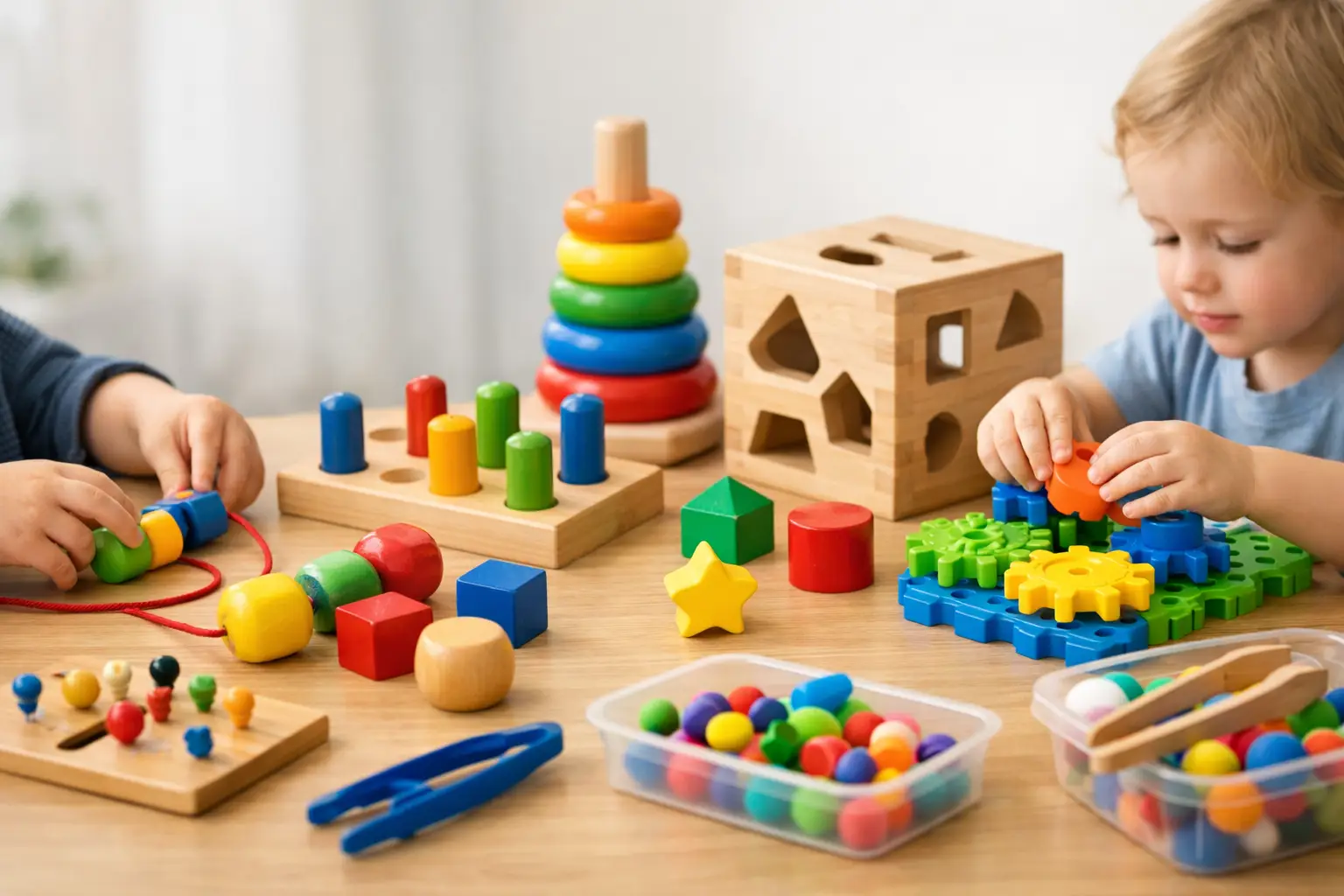
Stacking cups are a true early-childhood workhorse. Babies can bang them together, toddlers can stack them into a tower or nest them by size, and older children may use them in sensory or pretend play. Picking up and releasing each cup develops grasp control, while fitting cups together adds visual-spatial problem-solving.
Choose lightweight cups with smooth edges. For a younger baby, start with just two or three cups. Offering the whole stack at once can be more frustrating than fun.
2. Chunky shape sorters
A shape sorter gives toddlers practice rotating an object until it fits, which requires both hands to work together. One hand stabilizes the box while the other turns and places the shape. That coordination supports later tasks such as opening containers, holding paper while drawing, and using utensils.
Begin with a sorter that has a few basic shapes and clearly defined openings. More complex sorters are great for older toddlers, but a child who repeatedly cannot make a piece fit may simply need an easier starting point.
3. Large blocks and interlocking bricks
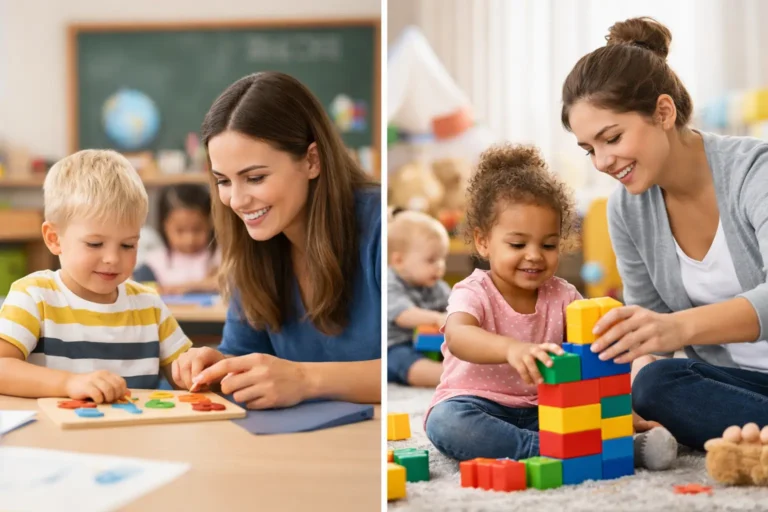
Blocks develop more than creativity. Large wooden blocks strengthen a child’s grasp and release, while oversized interlocking bricks add resistance that makes small hands work a little harder. Building a tower, pressing pieces together, and pulling them apart all require controlled movement.
For young toddlers, large blocks are usually easier to manage. Preschoolers may enjoy smaller interlocking sets, but only when they are safely beyond the mouthing stage. Avoid turning block play into a test. A wobbly tower built independently is more valuable than a perfect one built for them.
4. Pegboards and large pegs
Pegboards are especially helpful for practicing the pincer grasp, the thumb-and-index-finger movement used for picking up small items. Children also learn to aim, apply gentle pressure, and coordinate what their eyes see with what their hands do.
Start with large, easy-to-hold pegs. As your child becomes more confident, invite simple color patterns or ask them to fill one row. The goal is not to rush them into a worksheet-style activity. It is to give their fingers a satisfying job.
5. Puzzles with knobs or chunky pieces
A simple puzzle builds hand-eye coordination and persistence. Knob puzzles are ideal for children who are still learning to grasp and lift, while chunky inset puzzles offer a natural next step. Children must notice details, turn the piece, and keep trying when the first angle does not work.
Choose pictures your child recognizes, such as animals, vehicles, or familiar household items. A puzzle that matches their interests is more likely to get repeated use than one chosen only for its educational label.
6. Lacing cards and threading sets
Threading a lace through holes is excellent practice for bilateral coordination. One hand holds the card steady while the other guides the lace. This kind of play supports later skills such as tying shoes, dressing, and using classroom materials.
Lacing cards work best for preschoolers and older toddlers who can follow a simple sequence. For a younger child, try placing large rings on a standing post or threading oversized beads onto a thick cord with close supervision.
7. Play dough tools
Play dough is one of the most effective ways to strengthen little hands because it naturally invites squeezing, rolling, flattening, pinching, and pulling. Add child-safe scissors, rolling pins, cookie cutters, or plastic knives, and the activity can grow with your child.
This is a particularly helpful choice for children who avoid drawing or tire quickly during hands-on tasks. The resistance of dough builds strength without asking them to make a precise mark on paper. If store-bought dough is not practical for your family, homemade dough can work just as well when prepared safely.
8. Toy tongs, tweezers, and scoopers
Moving pom-poms, large buttons, or fabric scraps from one bowl to another with tongs looks simple, but it gives the fingers a serious workout. It strengthens the grasp pattern used for pencils and scissors while also helping children slow down and focus.
Use large, easy-squeeze tongs first. Small tweezers can be frustrating for many toddlers, so they are often better for preschool-age children. Keep any small objects closely supervised and choose larger materials for children under 3.
9. Busy boards and dressing boards
Zippers, buckles, snaps, latches, and Velcro tabs give children a practical reason to use their hands. Busy boards can support independent play, while dressing boards connect directly to daily routines. A child who practices a zipper during play may be more willing to try their jacket later.
The trade-off is that these toys can be challenging. Offer one fastening at a time and help only as much as needed. You can begin the zipper or loosen a buckle, then let your child finish the final step.
10. Stickers and reusable sticker scenes
Peeling a sticker from its backing takes concentration and a refined pincer grasp. Placing it on paper asks for accuracy, but it is still playful enough to hold a young child’s attention. Reusable sticker scenes add storytelling and can be an easier option because the stickers are often thicker.
If standard stickers create tears and frustration, peel up one corner for your child. That small adjustment preserves the learning without making the task feel impossible.
11. Crayons, dot markers, and water painting
Art supplies are fine motor toys in disguise. Chunky crayons encourage a child to make marks with control, dot markers offer satisfying hand pressure, and water painting lets children practice brush strokes without a major cleanup. These activities also help children build comfort with tools before writing becomes an expectation.
Toddlers do not need to hold crayons with a mature pencil grasp. Let them experiment. As control develops, their grip will naturally become more refined.
12. Construction sets with nuts, bolts, and connectors
For preschoolers, simple construction toys with large nuts, bolts, gears, or connectors offer a meaningful challenge. Twisting pieces together builds wrist rotation and coordination, while following a picture model develops planning. These sets can be a strong choice for children who are less interested in crafts but love vehicles, buildings, or figuring out how things work.
Choose pieces sized for your child’s age and patience. A set with dozens of parts may look impressive, but a smaller set that gets used weekly will do more for their development.
How to Choose Fine Motor Toys Without Overbuying
You do not need a shelf full of specialized products. A small rotation of toys that encourage different movements is usually enough. Consider one building toy, one puzzle or sorting toy, one sensory-strength activity such as play dough, and one practical play option such as a busy board or stickers.
Pay attention to how your child responds. If they throw pieces after a minute, the activity may be too hard, too easy, or simply not interesting that day. Try again later, change the setup, or join them for a few minutes to model one action. Your role is to make play feel possible, not to make every activity a milestone.
Make Fine Motor Practice Part of Everyday Life
Some of the best practice does not come from a toy aisle. Let your child help stir pancake batter, pull socks from a basket, place napkins on the table, turn pages in a book, or use a small sponge during cleanup. These tasks build capable hands while showing children that their contributions matter.
Offer a toy or activity, stay nearby, and resist the urge to correct every attempt. The slow, slightly messy work of learning to use little hands is exactly where confidence grows.