
Toddler Hitting Solutions That Actually Help
A hit can happen in a second: your toddler is frustrated over a block, a sibling gets too close, or you say no to another cookie. Then comes the sting, the shock, and often the worried question: “Why are they doing this?” Effective toddler hitting solutions start by treating the behavior as a skill gap, not a sign that your child is mean or that you have failed as a parent.
Toddlers are still learning how to handle big feelings, wait for what they want, communicate clearly, and control an impulse before their body acts. That does not make hitting acceptable. It does mean your response can be both firm and teaching-focused.
Why toddlers hit in the first place
Most toddlers hit because their feelings and impulses move faster than their language and self-control. A child may hit when they are angry, excited, overstimulated, tired, hungry, jealous, or unsure how to enter another child’s play. Some toddlers also experiment with cause and effect: “What happens if I do this?”
Hitting can increase during transitions, such as starting daycare, welcoming a new baby, moving homes, or dropping naps. It can also show up more often when a child is sick or has had a string of difficult days. Looking for the pattern does not excuse the behavior. It helps you prevent some of it and respond more effectively.
A toddler who hits once during a meltdown needs a different level of support than a child who is hitting daily across home, childcare, and playdates. The core approach is the same, but consistency and extra support matter more when the pattern is frequent or intense.
Toddler hitting solutions to use in the moment
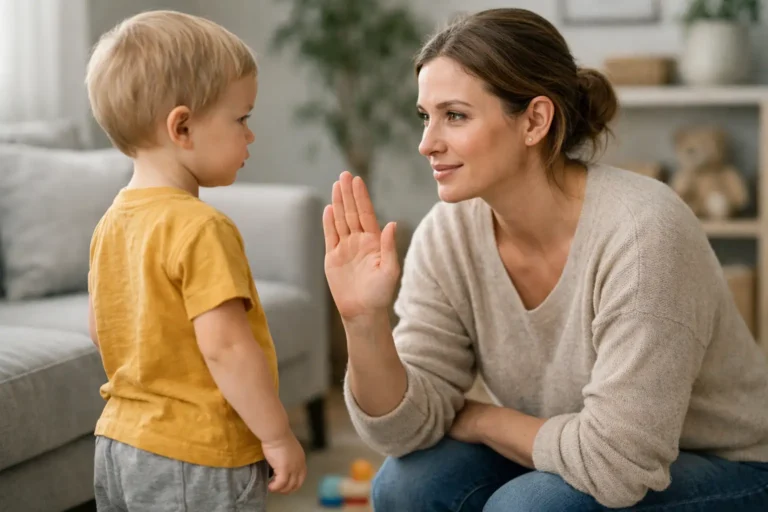
When your child hits, your first job is safety. Move close, gently block another hit if needed, and separate the children. Use a calm, low voice: “I won’t let you hit. Hitting hurts.”
Keep your words short. A toddler in a burst of anger cannot take in a long explanation about kindness, consequences, or disappointing behavior. A firm boundary delivered calmly is more likely to register than yelling, even when you are understandably upset.
Then turn your attention to the child who was hurt. You might say, “Are you okay? I’m going to help you.” This sends a clear message that safety matters, without turning the moment into a dramatic source of attention for the child who hit.
Once everyone is safe, help your toddler settle. Depending on their age and temperament, that may mean sitting with you in a quiet spot, taking a few slow breaths together, stomping feet on the floor, or simply having space nearby while you stay available. Avoid demanding an immediate apology while your child is still dysregulated. A forced “sorry” can become a word said under pressure rather than an understanding of repair.
When calm returns, name what happened in simple language: “You were mad that Maya had the truck. You hit. Hitting is not okay. Next time, say, ‘My turn,’ or ask me for help.” This sequence matters: acknowledge the feeling, hold the limit, and offer a safer action.
Teach the replacement behavior before the next conflict
Stopping hitting is only half the work. Your toddler needs a usable alternative for the exact moments when their body wants to strike. Practice these skills when everyone is calm, not only after an incident.
For a young toddler, the replacement may be very simple: gentle hands, handing over a toy, pointing to a picture, or coming to get an adult. For an older toddler, teach short phrases such as “Stop,” “My turn next,” “I need space,” “Help me,” and “I’m mad.” You can practice them during play with stuffed animals or act out a common conflict using toy cars.
It also helps to give anger a safe physical outlet. “You can hit this pillow,” “You can stomp,” or “You can squeeze your hands” offers a clear distinction between having an angry feeling and hurting a person. The goal is not to make your child suppress anger. It is to show them what to do with it.
Use praise that identifies the skill you want repeated. Instead of a broad “Good job,” try: “You were upset, and you used words,” or “You kept your hands gentle when you wanted that toy.” Specific feedback helps toddlers connect their choice to the positive result.
Prevent the situations that make hitting more likely
Prevention will not eliminate every hit, but it can lower the number of hard moments. Start by noticing when the behavior happens. Is it late afternoon before dinner? During crowded playdates? When a sibling touches a favorite toy? A quick note on your phone for a few days can reveal a useful pattern.
If sharing is a frequent flashpoint, do not expect toddlers to manage long turns with highly preferred toys. Put away the one special item that always causes conflict, offer similar toys when possible, and stay close enough to coach. Saying “You can have a turn when Sam is done” is more realistic than insisting a toddler instantly share something they are deeply attached to.
Prepare your child before predictable challenges. Before visiting the playground, say, “There will be lots of kids. If you want a toy, you can say, ‘Can I have a turn?’ If you feel mad, come find me.” Before a sibling enters their play space, help your toddler choose a few toys they do not want to share right then.
Regular meals, sleep, movement, and connection also matter. Toddlers do not hit simply because they are tired, but fatigue and hunger can shrink their ability to cope. A brief reconnecting routine after daycare or work, even ten minutes of child-led play, can reduce the pressure that spills out later.
What consequences work for toddler hitting?
A consequence should be immediate, related to the behavior, and brief. If your toddler hits during play, the play pauses. You can say, “I won’t let you hit. We’re taking a break from playing with friends.” If they hit while using a toy, the toy may be put away for a short time because it was not used safely.
The purpose is not punishment. It is to connect the boundary to what happened: when bodies are unsafe, the activity stops and an adult helps everyone reset. Long time-outs, lectures, shaming statements, or taking away unrelated privileges hours later usually teach less at this age.
Avoid hitting, swatting, or threatening physical punishment in response. Even when intended as discipline, it can send the confusing message that hitting is an acceptable way for a bigger person to solve a problem. Toddlers learn most from what adults consistently model under stress.
After the calm-down, guide repair in a way your child can manage. They may offer a gentle touch if the other child wants one, help bring an ice pack, pick up a knocked-over tower, or say sorry. Repair should never be forced on the child who was hurt. “Would you like space or a gentle hug?” respects their feelings too.
Stay consistent with other caregivers
Toddlers learn faster when the adults around them use similar language and limits. If your child attends childcare, ask what tends to happen before hitting and share the short phrases you use at home. Agreeing on a response such as “I won’t let you hit. Hands are for helping. Say ‘stop’ or get a teacher” gives your child a familiar script in both places.
This does not require every caregiver to parent identically. Grandparents, teachers, and co-parents may have different styles. What matters most is that everyone responds clearly, protects the child who was hurt, and helps your toddler practice a safer option.
When to ask for additional support
Hitting is common in toddlerhood, especially between ages 1 and 3, and many children improve with patient teaching and consistent boundaries. Still, speak with your child’s pediatrician if the behavior is severe, frequent, escalating, causes significant injuries, or continues well beyond the toddler years without improvement.
It is also worth checking in if hitting happens alongside concerns about language delays, social communication, sleep, sensory overwhelm, anxiety, or major changes in mood. Your pediatrician can help you consider whether a developmental screening, behavioral health support, or early intervention evaluation would be useful. Seeking guidance is not overreacting. It is a practical way to get your child the right tools sooner.
Your calm response will not make every conflict disappear overnight. But each time you block the hit, name the limit, and teach a safer choice, you are giving your toddler a path they can eventually use on their own.