
How to Stop Sibling Jealousy Without Taking Sides
A toddler may suddenly want the baby’s bottle after months of drinking from a cup. An older child may melt down the minute you sit to feed their new sibling. These moments can feel personal, but they are usually a child’s way of asking, “Do I still matter here?” Learning how to stop sibling jealousy starts with seeing the need underneath the behavior, not simply trying to make children get along.
Jealousy between siblings is common, especially after a new baby arrives or when one child is going through a big developmental change. It does not mean you have failed to create a loving family. With steady boundaries, individual attention, and a few practical changes to daily routines, children can learn that there is enough love, safety, and space for everyone.
Why sibling jealousy happens
Children do not experience family changes with an adult perspective. A new sibling may represent less one-on-one time, different rules, more noise, or a parent who seems distracted and tired. Even a child who was excited about a baby may struggle once the real-life changes begin.
Jealousy also shows up well beyond the newborn stage. A preschooler may resent the attention a younger sibling gets for learning to talk. A school-age child may feel overlooked when a younger child needs extra support. Siblings can also compete when they are close in age, have very different temperaments, or are repeatedly compared in front of others.
The goal is not to convince a child that jealousy is wrong. Feelings are allowed. Hurting, insulting, controlling, or excluding a sibling is not. That distinction helps you respond with compassion while still holding a clear limit.
How to stop sibling jealousy by building security
The most effective strategies do not require perfectly equal attention every hour. Children need to trust that they are seen and valued as individuals. Fairness matters, but fairness is not always identical treatment.
Name the feeling without agreeing with hurtful behavior
When your child says, “You love the baby more,” the instinct may be to immediately correct them. Try slowing down instead. You might say, “It feels really hard when I need to hold the baby and you want me, too. I’m listening.”
This response does not confirm that you love one child more. It shows that you understand the emotional message. Once your child feels heard, set the boundary plainly: “You can be mad, but you cannot push the baby. I will keep both of you safe.”
For younger children, keep the words short. “You wanted me. Waiting is hard. I won’t let you hit.” Repeating the same calm language over time is more helpful than a long explanation during a meltdown.
Create small, predictable moments of one-on-one time
A child does not always need a big outing or an elaborate activity. Ten focused minutes can matter more than an hour in the same room while you answer messages, clean up, or manage everyone else’s needs.
Build a short “special time” into the day when possible. Let your child choose a simple activity within reasonable limits: drawing, building blocks, a walk outside, reading two books, or helping make a snack. Put your phone away and let the child lead. Predictability is powerful. If they know their time with you happens after dinner or before bedtime, they have something concrete to count on when they need to wait.
If you have multiple children, the amount of time may not be equal every day. One child may need extra support after a hard preschool drop-off, while another gets their turn the next day. You can say, “Your brother needed extra help this morning. I have time with you after bath.” This teaches that needs can be different without changing your love.
Avoid comparisons, even positive ones
Comments such as “Why can’t you be helpful like your sister?” often increase resentment quickly. But even praise-based comparisons can create pressure: “Your big brother never had accidents at your age.” Children may hear that their place in the family depends on being easier, smarter, calmer, or more advanced.
Describe what you see instead. Say, “You put your shoes on after one reminder,” or, “You kept trying even when that puzzle was frustrating.” Give each child feedback about their own effort, growth, and choices. This helps siblings feel less like they are competing for a single spot.
Give older children a role, not a responsibility
Many older siblings enjoy helping, but help should be an invitation, not a job they cannot escape. Asking, “Would you like to choose the baby’s pajamas or keep playing?” gives your child some control. Thank them for joining in, but do not make them feel responsible for the baby’s comfort or your stress level.
Be especially careful with phrases like, “You’re the big kid, so you should know better.” Older children still need comfort, silliness, and support. They may be more capable, but they are not less deserving of care.
Handle fights without making one child the villain
Sibling conflict is often loud, repetitive, and exhausting. Still, rushing in as a judge can reinforce competition. One child gets labeled as the troublemaker, while the other learns that crying louder wins adult support.
Start by stopping unsafe behavior. “I won’t let anyone throw toys.” Separate children if necessary, then focus on calming bodies before asking for explanations. A hungry, overstimulated child cannot learn much from a detailed lecture.
When everyone is calmer, give each child a brief chance to speak. You might say, “You wanted the truck. Your sister grabbed it. Then you hit. Both of you needed help.” This is not about assigning equal blame when behavior was clearly unsafe. It is about helping children understand the chain of events and practice a better next step.
Offer a simple repair. The child who threw a block may help check that their sibling is okay, bring an ice pack, or help rebuild what was knocked down. An apology is useful when it is genuine, but forced apologies often become empty words. Repair teaches more than shame does.
Do not require sharing every prized item
Some conflict is preventable. Children need to learn turn-taking, but they do not need to share every possession at every moment. A favorite stuffed animal, special blanket, birthday gift, or carefully built creation can be protected.
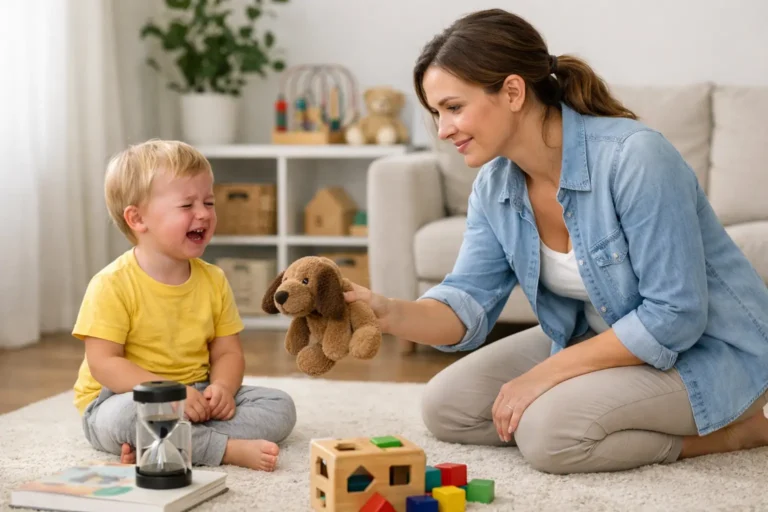
Create a few clear household rules: shared toys can have turns, personal comfort items are off-limits, and work that is still in progress should be respected. For toddlers, use a timer and stay nearby to coach. For older children, help them negotiate: “You can have it for ten more minutes, then it is your brother’s turn.”
Watch for the patterns that make jealousy worse
Sibling jealousy often spikes at predictable times: when you are feeding the baby, preparing dinner, getting everyone out the door, or trying to make bedtime happen. Rather than expecting children to cope perfectly during these pressure points, plan for them.
Keep a small basket of quiet activities near the place where you feed the baby. Offer your older child a choice before you begin: “Do you want stickers or an audiobook while I feed the baby?” At dinner, give each child one small, age-appropriate task, such as putting napkins on the table or choosing between two vegetables. At bedtime, protect a short individual ritual whenever you can, even if it is only a song, a question about their day, or a two-minute cuddle.
Also look at whether a child is being asked to wait too often. You cannot meet every request immediately, especially with a baby or multiple children. But saying, “I hear you. I will help when I finish this diaper,” and following through builds trust. Vague promises such as “later” can feel like a dismissal when they happen repeatedly.
What to say when a child is jealous of a new baby
A child may say they want the baby to go away, ask if you can return them, or act like a baby themselves. These reactions can be alarming, but they are usually signs of adjustment, not a lack of love. Stay calm and direct: “You wish things could be like they were before. You can tell me that. The baby is part of our family, and I will help you with these big feelings.”
Allow some gentle regression where it is practical. Your child may want to be carried, use a sippy cup, or have you tuck them in differently for a while. You do not have to turn back every developmental step, but offering extra reassurance can reduce the need to compete.
Make sure the baby occasionally has to wait, too. In a warm voice, say, “Baby, I’m helping your sister right now. You can wait a moment.” Your older child benefits from hearing that their needs matter aloud. It may feel small, but it changes the story from “the baby always comes first” to “everyone gets cared for.”
When sibling jealousy needs more support
Most jealousy improves as children adjust and parents respond consistently. Consider talking with your child’s pediatrician or a child mental health professional if aggression is frequent or escalating, a child repeatedly tries to harm a sibling or themselves, behavior changes are severe, or your child seems persistently anxious, withdrawn, or depressed.
Extra support can also help if a child has developmental differences, sensory needs, a major medical issue, or a recent family stressor such as a move, divorce, or loss. Getting guidance is not overreacting. It is a practical way to give your family more tools.
Your children do not need to be best friends every day. They need a home where their feelings can be named, their bodies are kept safe, and they learn that love is not something siblings have to win from one another.