12 Best Sensory Toys for Calmer, Happier Play
A bin of dry rice, a squishy ball, or a set of nesting cups can buy you ten peaceful minutes while giving your child’s brain something useful to do. The best sensory toys are not necessarily the loudest, most colorful, or most expensive options. They are toys that safely invite your child to touch, move, listen, look, build, or pretend in a way that feels engaging rather than overwhelming.
Sensory play supports the way young children learn about their bodies and environment. It can also be a practical tool during long afternoons, transitions, or those moments when your child seems to need to move, squeeze, chew, or make a little mess. The goal is not to “fix” normal behaviors or create a perfectly calm child. It is to offer healthy, age-appropriate ways to explore and regulate.
What Makes a Sensory Toy Worth Buying?
A useful sensory toy gives a child something active to do. They might press, pour, stack, spin, stretch, carry, or sort. Open-ended toys tend to last longer because a baby, toddler, and preschooler can use the same item differently as their skills grow.
Think about your child’s interests before buying a large assortment. A child who constantly climbs onto the couch may benefit more from movement-based play than another set of fidget toys. A child who loves washing hands, stirring batter, or playing in the dog’s water bowl may be drawn to scoops, cups, and supervised water play.
Also consider your household reality. Kinetic sand can be wonderful, but it may not be the right fit if you have a crawling baby nearby or little patience for cleanup before dinner. The best choice is one you will actually feel comfortable bringing out regularly.
12 Best Sensory Toys by Play Style
1. Textured balls
Soft balls with bumps, ridges, or different fabrics are a strong first sensory toy for babies. They encourage reaching, grasping, rolling, and two-handed play. For older toddlers, toss them into a laundry basket or roll them down a ramp to add movement and early problem-solving.
Choose balls that are large enough not to create a choking risk and easy to wipe clean. Avoid toys with loose decorative pieces, beads, or weak seams.
2. Stacking cups
Stacking cups are deceptively versatile. Babies mouth and bang them, toddlers stack and knock them down, and preschoolers use them for pretend soup, sand play, and water experiments. Cups with small holes on the bottom add a fun cause-and-effect element in the bath.
This is a particularly practical option for families who want one low-cost toy that travels well and does not require batteries.
3. Play scarves
Lightweight, child-safe play scarves invite movement without taking over the room. Young children can wave them, hide objects underneath, dance to music, stuff them into a tissue box, or use them in pretend play. Their bright colors add visual interest, but the real value is in the movement and imagination they encourage.
Supervise babies closely, since any fabric item can pose a risk if it covers the face. Store scarves out of reach when playtime is over.
4. A simple sensory bin
A sensory bin can be as simple as a shallow container filled with large pom-poms, water, shredded paper, or clean mud-free snow brought inside for a few minutes. For toddlers and preschoolers, add scoops, tongs, cups, toy animals, or chunky vehicles.
The filler matters. Dry beans, rice, and small pasta are common choices for older children, but they are choking hazards for babies and children who still mouth objects. If your child is under 3 or puts items in their mouth, choose larger taste-safe materials and stay close.
5. Dough and modeling clay
Squeezing, rolling, pinching, and cutting dough strengthens little hands for later tasks such as using utensils, buttoning clothes, and holding a pencil. It also gives children a satisfying outlet when they seem restless or tense.
For young toddlers, use a non-toxic dough and supervise closely. Homemade taste-safe dough can be a good option for children who are still likely to take a bite, although “taste-safe” does not mean it should become a snack. Preschoolers can add cookie cutters, blunt tools, and natural items such as leaves for more detailed play.
6. Water play tools
A plastic tub, a few cups, a sponge, and a turkey baster can hold a toddler’s attention surprisingly well. Filling, pouring, squeezing, and watching water move all provide rich sensory feedback. Water play also works well outdoors when the weather allows.
Keep the water level very low and provide hands-on supervision at all times. Even a small amount of water can be dangerous for young children. Empty the container as soon as play is finished.
7. Chunky wooden blocks
Blocks provide sensory input through weight, texture, sound, and movement, while also building coordination and spatial awareness. Wooden blocks have a satisfying feel and gentle knocking sound, but large plastic foam blocks may work better for a child who throws toys or for a home with hard floors.
Rather than asking your child to build a tower “the right way,” start with an invitation: Can you make a bridge for the car? Can we build something taller than your knee? This keeps the focus on exploration.
8. Push-and-pull toys
For a newly mobile toddler, a sturdy push toy or pull-along animal can meet a powerful need for movement. These toys help children practice balance, coordination, and confidence as they move through a room or down a safe sidewalk.
Look for a stable design and use it on a clear surface. A push toy is not a substitute for close supervision, especially around stairs or uneven outdoor spaces.
9. A mini trampoline with a handle
Some children seek big body movement all day long. A small trampoline designed for young children can offer a contained way to jump, land, and use energy. This kind of play can be especially helpful before a difficult transition, such as getting dressed or sitting down for a meal.
It depends on your child’s age, coordination, and your available space. Follow the manufacturer’s age and weight guidance, use it on a level surface, and allow only one child at a time.
10. Musical instruments
Egg shakers, hand drums, bells, and xylophones introduce sound, rhythm, and cause and effect. They can support language play too: copy a beat, sing a familiar song, or take turns being the “leader.”
Sound-sensitive children may prefer softer instruments or brief sessions. You do not need a full band set. Two instruments and a few songs are often plenty.
11. Sensory bottles
A securely sealed sensory bottle filled with water, glitter, large beads, or colorful objects can give a child a quiet visual focus. Rolling or shaking the bottle invites observation without requiring a big setup. They are useful in a stroller, waiting room, or calm-down corner.
Make sure the lid is tightly sealed, ideally with a permanent adhesive if you are making one yourself. Skip small loose pieces if there is any chance the bottle could break or be opened.
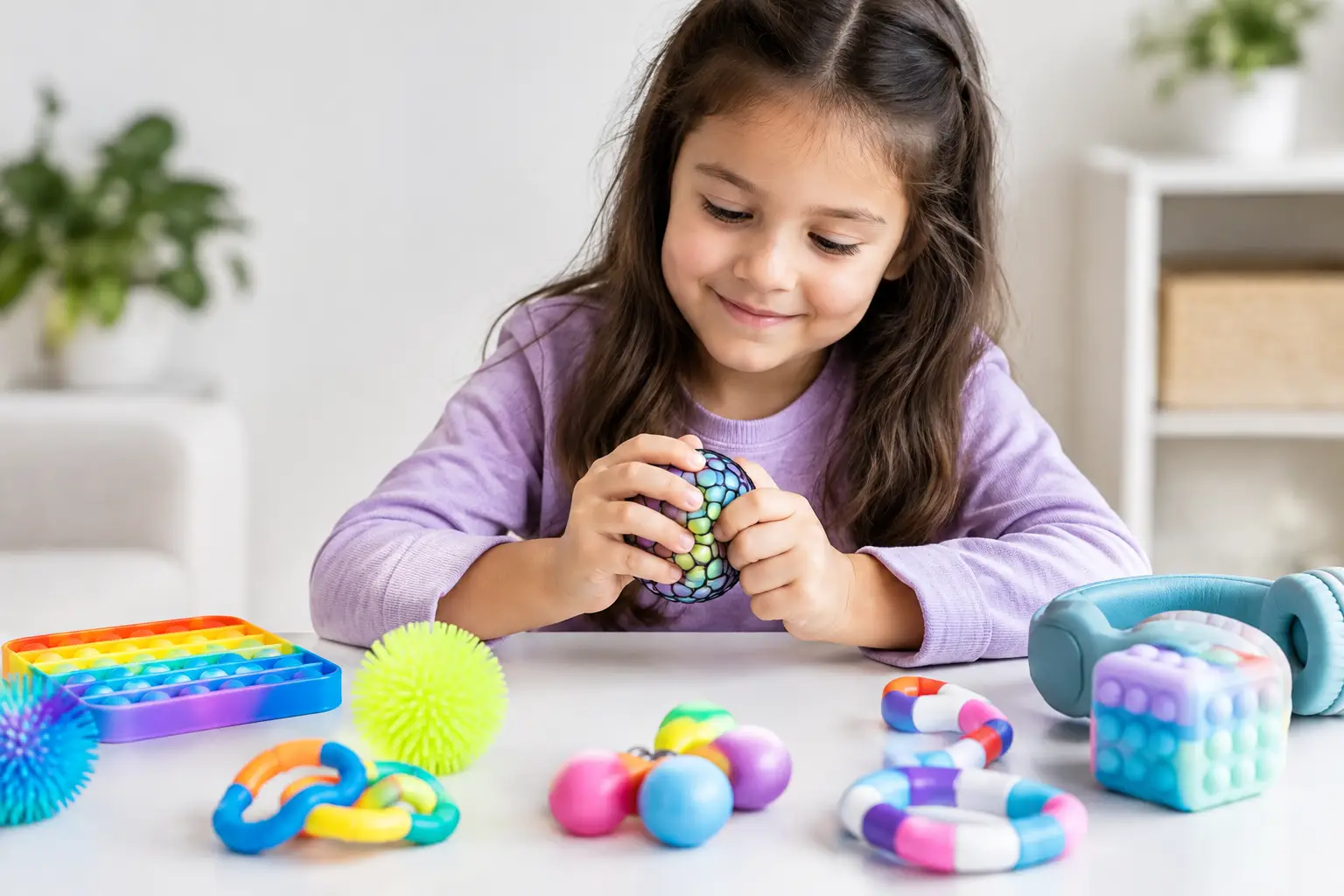
12. Fidget toys for older preschoolers
For a preschooler who wiggles during stories, car rides, or waiting times, a simple fidget toy may help keep hands busy. Options with buttons, textured surfaces, or parts that twist can be satisfying when used intentionally.
Fidgets are not magic behavior tools, and some are more distracting than calming. Introduce one during a low-pressure activity first. If your child starts tossing it, arguing over it, or focusing on the toy instead of the task, save it for free play instead.
How to Match Sensory Toys to Your Child
Pay attention to patterns rather than labeling every preference. Does your child relax while scooping and pouring? Do they seek rough-and-tumble play after preschool? Do loud, crowded activities lead to tears or shutdowns? Those observations can guide what you offer.
Children who seek movement may enjoy obstacle courses, pillows to climb over, push toys, dancing, or supervised jumping. Children drawn to touch may enjoy dough, water, finger paint, and textured balls. A child who becomes overwhelmed by noise may prefer quieter options, such as blocks, sensory bottles, or soft scarves, with less visual clutter around them.
Offer, do not force. Some children dislike sticky textures, while others could play in paint all afternoon. Respecting a child’s “no” is part of helping them understand their own sensory preferences. You can revisit an activity later in a different form, such as using a paintbrush instead of finger paint or dry scoops before water play.
A Quick Safety Check Before Play
Sensory toys require the same safety thinking as every other toy in your home. Follow the age recommendation, inspect toys regularly for cracks or loose pieces, and keep small parts away from babies and young toddlers. Supervision is especially important around water, balloons, magnets, button batteries, stretchy items, and sensory-bin fillers.
If your child frequently mouths nonfood items past the toddler years, seems unusually distressed by everyday sounds or textures, or sensory needs are making daily routines very difficult, bring your observations to their pediatrician. This does not mean something is necessarily wrong. It simply gives you a chance to get personalized, expert-backed guidance.
You do not need a dedicated playroom or a cart full of specialty products to support sensory development. Start with one or two options that match your child’s age and interests, then notice what brings focused, happy play. Often, the toy that earns a permanent spot in your routine is the simple one your child returns to again and again.