Childproofing Stairs for Safer Toddler Years
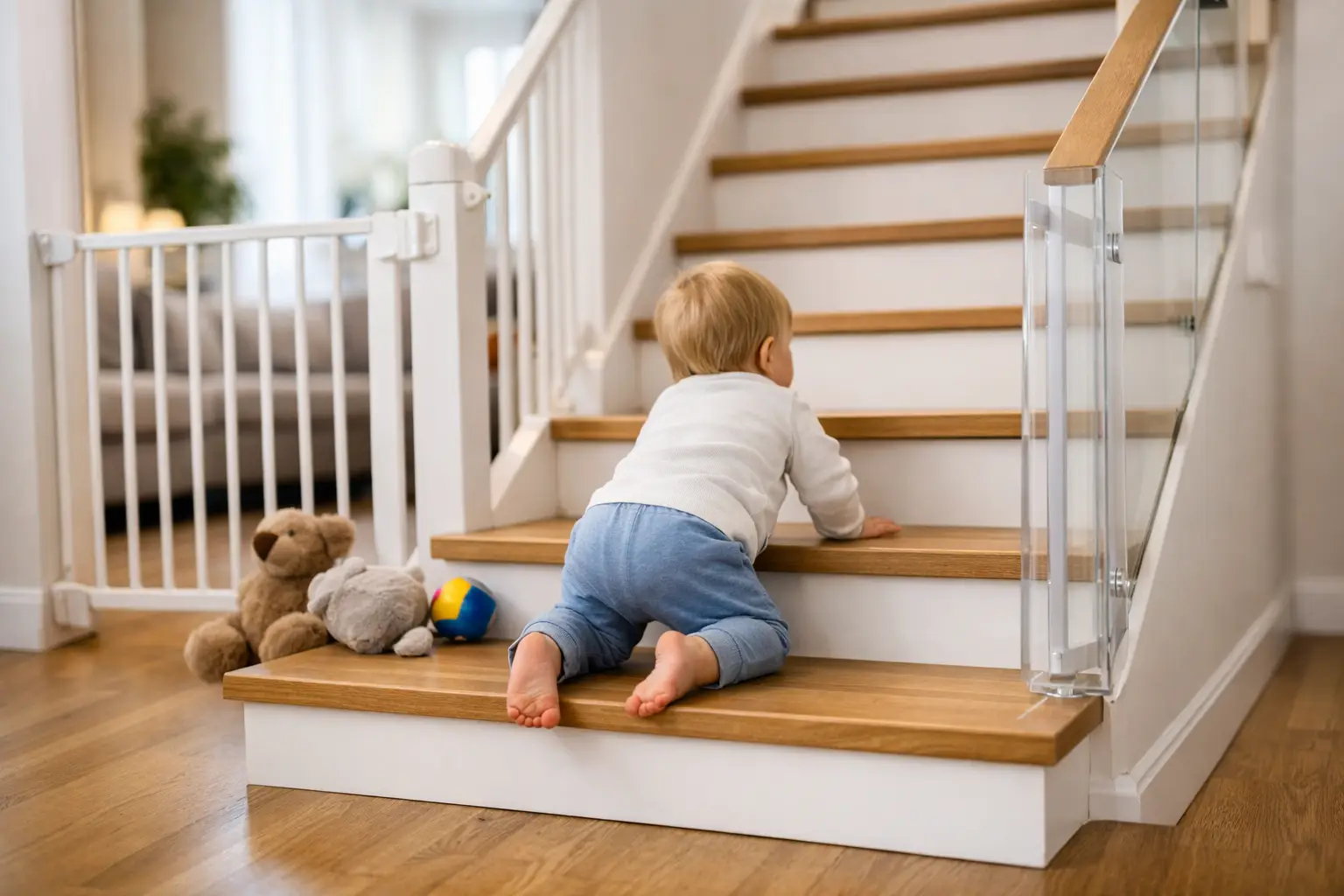
The moment your baby learns to crawl, the staircase can become the most interesting place in the house. Childproofing stairs is not about making your home feel off-limits or overly restrictive. It is about creating a reliable layer of protection while your child is still developing balance, judgment, and the ability to follow directions consistently.
Falls on stairs can happen quickly, especially during rushed mornings, while carrying laundry, or when a curious toddler decides to practice climbing before you are nearby. A few well-chosen safety changes can give your child room to grow while helping you feel more confident about everyday life at home.
When to Start Childproofing Stairs
Start before your baby becomes mobile if possible. Many babies begin rolling, scooting, or crawling earlier than parents expect, and once a child can move independently, stairs quickly become a target for exploration.
If your baby is already crawling or pulling up, make stair safety a priority now. You do not need to wait until they can climb. In fact, setting boundaries before stairs become a favorite challenge is often easier than trying to change a well-established habit later.
Keep in mind that childproofing is not a one-time project. Your setup will need to change as your child goes from crawling to climbing, then eventually to using the stairs with growing independence. What keeps a 9-month-old safe may not be enough for a determined 2-year-old who has learned how to open a latch or move furniture.
Childproofing Stairs Starts With the Right Gates
Safety gates are the most effective first line of defense for most homes with young children. Ideally, use a gate at both the top and bottom of every staircase your child can access. A gate at the bottom prevents climbing when you are not close by, while one at the top helps prevent a serious fall from the landing.
Choose a hardware-mounted gate for the top
The gate at the top of a staircase should be hardware-mounted, meaning it is secured directly to the wall, banister, or door frame. Pressure-mounted gates can shift if pushed hard enough, which makes them a poor choice at the top of stairs. A child leaning against one, or an adult catching a foot on the bottom bar, could cause the gate to come loose.
Look for a gate that opens away from the stairs. This detail matters because a gate that swings over the stair opening can create an extra fall risk when it is opened. If your stair layout is unusual, such as a banister on one side and a wall on the other, you may need an installation kit designed to create a secure mounting surface.
Pressure-mounted gates can work at the bottom
A pressure-mounted gate may be appropriate at the bottom of stairs if it fits snugly and is used according to the manufacturer’s instructions. It is often easier to remove temporarily for guests or when you need to move bulky items. Still, check it regularly. Toddlers pull, shake, and climb on gates, and a gate that felt firm last month may need adjustment now.
Avoid accordion-style gates with large openings, gates with wide slats that can trap a child’s head, and older models that do not meet current safety standards. The gate should have a reliable latch that adults can operate but young children cannot easily figure out.
Use gates consistently
A safety gate only works when it is closed and latched. This can be the hardest part during busy family routines, especially when older siblings move quickly between floors. Make it a household rule: the last person through the gate closes it.
If grandparents, babysitters, or friends help care for your child, show them how the gate works. A complicated latch may be secure, but it is less useful if caregivers leave it open because they are unsure how to close it.
Secure the Staircase Itself
Gates reduce access, but the stairs should also be as safe as possible in case your child reaches them while supervised or a gate is accidentally left open.
Start with the railing. It should be firmly attached and easy for an adult or older child to hold. Check for loose spindles, sharp edges, peeling paint, splinters, or gaps wide enough for a child to squeeze through. If the gaps between balusters are wider than 4 inches, speak with a qualified contractor about safe options for enclosing them.
Do not rely on decorative netting, loosely attached fabric, or makeshift barriers around a banister. These may look like quick fixes, but children can pull them down, get tangled in them, or use them as climbing material.
Lighting also makes a real difference. Dim stairs are harder for everyone to navigate, particularly during early mornings and overnight wake-ups. Make sure the stairwell has bright, dependable lighting, and consider a night-light near the landing if your family regularly moves around after bedtime.
If your stairs are wood or tile, non-slip treads can improve traction. Choose a product that lies flat and stays securely in place. A loose runner or curled edge can create another tripping hazard, so inspect it often.
Keep Stair Landings Clear
The most practical safety upgrades are sometimes the least exciting. A clear staircase gives little feet fewer opportunities to trip and gives adults a better chance of seeing where they are stepping.
Avoid leaving toys, shoes, books, baskets, laundry, or pet items on the stairs or landings. It is tempting to set something there as a reminder to carry it upstairs later, but stairs are not storage space. A single toy car can be enough to cause a fall when someone is carrying a child.
Furniture placement matters too. Keep chairs, storage cubes, and large toys away from gates and railings. Toddlers are creative problem-solvers, and a nearby chair can quickly become a step stool for climbing over a gate or reaching a banister.
For homes with pets, notice where food bowls, beds, and toys tend to collect. A sleepy dog stretched across the bottom step or a chew toy on the landing can be risky for a child who is still unsteady on their feet.
Teach Stair Skills as Your Child Grows
Gates and supervision are essential, but your child will eventually need to learn how to use stairs safely. Begin practicing when they show readiness, often after they can walk steadily on flat ground. Stay close enough to intervene, even if they seem capable.
Teach your child to hold the railing and take one step at a time. For younger toddlers, facing the stairs and holding a hand may be appropriate. As they become steadier, encourage them to use the handrail rather than rushing, jumping, carrying large toys, or climbing while wearing slippery socks.
Simple, repeated language helps. You might say, feet on the steps, hand on the rail, or stairs are for walking. The goal is not to frighten your child. It is to build a predictable routine they hear every time.
Toddlers often want to practice climbing because it feels like a big accomplishment. When you have time, let them practice with full supervision instead of making stairs feel completely forbidden. This helps them gain coordination while learning that stair use happens with an adult, not during unsupervised exploration.
Common Stair Safety Mistakes to Avoid
One common mistake is removing gates too early because a child seems to understand the rules. Toddlers can follow a rule beautifully one day and forget it the next when they are excited, tired, or trying to follow an older sibling. Developmental readiness is not the same as consistent safety judgment.
Another is using a gate that is not properly installed. If you can push the gate out of place with moderate pressure, it needs adjustment. Check hardware-mounted gates periodically as well, especially after seasonal changes that can affect wood trim or after your child starts rattling the gate more aggressively.
Finally, avoid assuming older siblings will always remember to close gates. They can be helpful partners in home safety, but adults should still check gates regularly and make the environment safe enough to account for ordinary family forgetfulness.
Know When Your Setup Needs an Update
Reassess your stair safety plan whenever your child gains a new skill. A baby who only crawls needs different protection than a preschooler who can climb, unlatch handles, and drag objects across the room. You may also need to update your setup after moving furniture, renovating, welcoming a new baby, or bringing a newly mobile child into a home that was previously arranged for older kids.
Most children will eventually outgrow gates, but there is no single age for removing them. Consider your child’s behavior, impulse control, stair skills, and the layout of your home. A child who uses stairs carefully with supervision may still need barriers during sleep times, busy transitions, or when adults are focused on a younger sibling.
A safer staircase does not require perfection. It comes from a few dependable systems: secure gates, clear steps, solid railings, and steady practice. Those small choices protect your child while giving them the confidence to build one new skill at a time.