Independent Play Activities for Toddlers That Work
A toddler who follows you into the kitchen, pulls at your leg during a phone call, or loses interest in every toy after two minutes is not doing anything wrong. They are still learning how to play, how to handle a little boredom, and how to feel secure when you are nearby but not actively involved. Independent play activities for toddlers can help build those skills without expecting your child to suddenly entertain themselves for an hour.
The goal is not to make your toddler need you less. It is to give them repeated, manageable chances to explore, create, and problem-solve while knowing you are available. With a simple setup and realistic expectations, independent play can become a useful part of your family’s day.
What independent play looks like for toddlers
Independent play means your child is leading the activity without needing constant directions, entertainment, or rescue from every small frustration. You may be in the same room folding laundry, making lunch, or sitting nearby with coffee, but your toddler is engaged in their own play.
For most toddlers, this starts in very small stretches. A young 1-year-old may play independently for two or three minutes before checking back in. Many 2- and 3-year-olds can gradually manage longer periods, especially with familiar materials and a predictable routine. Temperament, sleep, hunger, and a child’s developmental stage all matter, so there is no single “right” amount of time.
Think of independent play as a skill your child practices, not a test they pass or fail.
Why solo play matters
When toddlers have room to direct their own play, they practice making choices: Which block goes on top? Should the stuffed animal go to bed? What happens if the car rolls down this ramp? Those small decisions support early problem-solving, creativity, persistence, and confidence.
There is a parenting benefit, too. Brief, reliable windows of play can make daily tasks feel less frantic. But the biggest payoff is not getting more done. It is helping your child learn that they can be curious, capable, and content without an adult creating every moment for them.
That said, independent play does not replace connection. Toddlers still need plenty of warm, responsive interaction, active play, conversation, and comfort. Children are often more able to play on their own after they have had a few minutes of focused attention from you.
Set up the environment before expecting the skill
A toddler cannot settle into play if the space is unsafe, overwhelming, or packed with toys they cannot use without help. Start with one child-safe area where you can supervise easily. This might be a gated section of the living room, a playroom corner, or a mat near the kitchen.
Keep only a few options available at once. A room full of toys can lead to dumping, bouncing between activities, and asking you what to do next. A smaller selection makes it easier for your child to choose and stay with something.
Try placing materials in low, open baskets or on a shelf where your toddler can reach them independently. Save complicated toys, tiny pieces, messy supplies, and anything requiring close supervision for shared play. The best independent activities are usually simple, open-ended, and familiar.
Start with connection, then step back
Before asking your toddler to play alone, spend five to ten minutes being fully present. Build a block tower, read a short book, or sit on the floor and follow their lead. Then name the transition clearly: “I’m going to put the laundry away. You can keep building with your blocks. I’ll be right here.”
At first, stay close. You might sit nearby without taking over or comment occasionally: “You found the red cup.” As your child gets more comfortable, slowly reduce your involvement. This gradual approach is usually more successful than leaving the room and hoping they adjust.
10 independent play activities for toddlers
The best activities match your child’s current abilities. If an activity is too difficult, your toddler will need your help right away. If it is too easy, they may lose interest quickly.
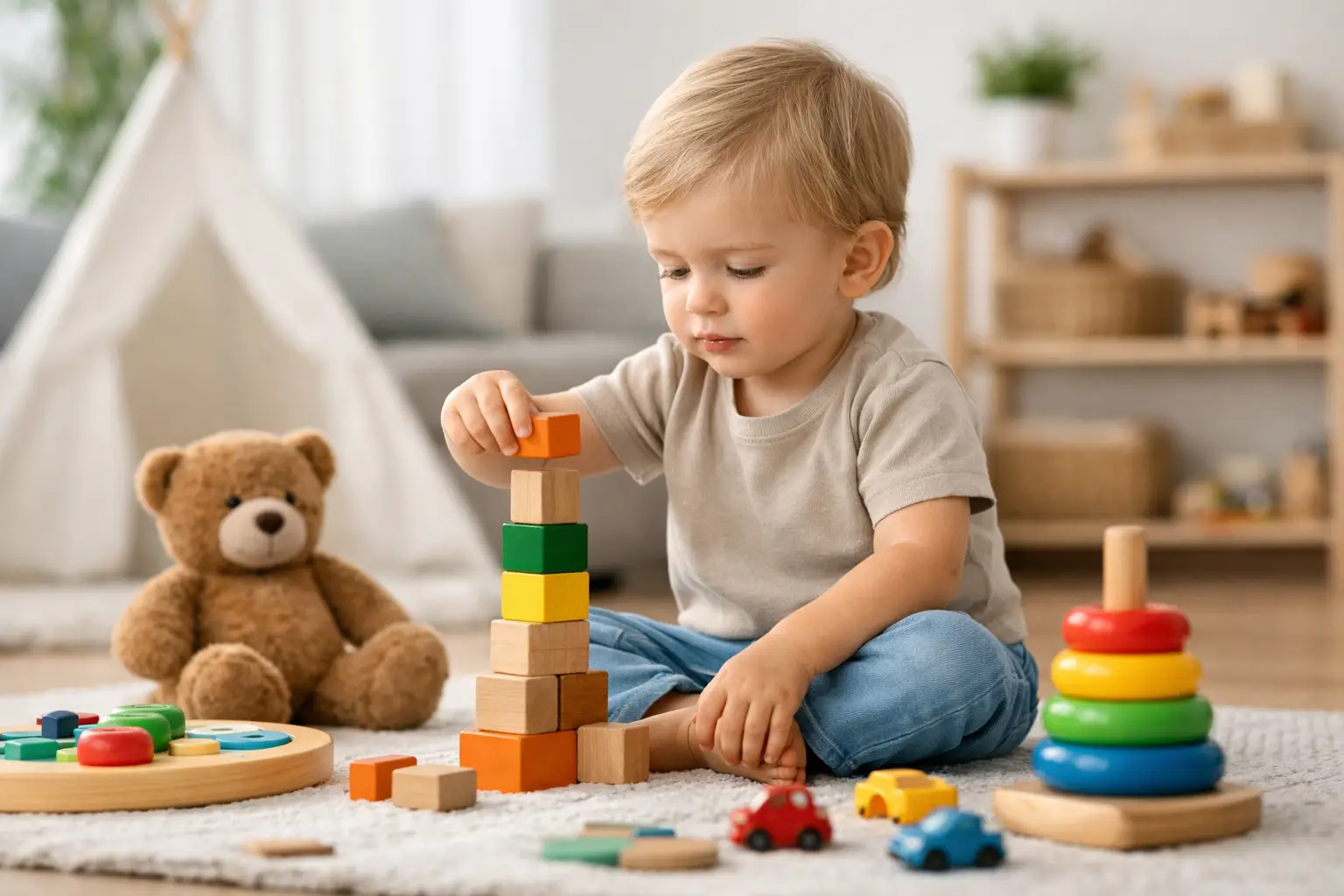
- Block building and knocking down. Offer a small basket of chunky wooden blocks, foam blocks, or large interlocking bricks. Toddlers can build towers, line pieces up, make “houses,” and enjoy the satisfying work of knocking structures down.
- Toy animal or vehicle play. A few animals, cars, or figures paired with a simple prop can create a whole story. Try a cardboard box as a garage, a towel as a road, or a shoebox as a barn. You do not need an elaborate play scene.
- Sticker play. Large, easy-peel stickers and a sheet of paper can hold a toddler’s attention surprisingly well. For younger toddlers, place the stickers’ backing edge slightly peeled to reduce frustration. Supervise closely if your child still mouths small items.
- A book basket. Board books, touch-and-feel books, and familiar picture books are ideal for quiet independent time. Rotate a few books every week rather than putting out every title at once.
- Simple puzzles. Chunky knob puzzles, inset puzzles, and matching boards give toddlers a clear task without too many rules. Start with puzzles they can complete mostly on their own, even if the pieces are not always placed perfectly.
- Pretend kitchen or baby care. A doll, a small blanket, a few play dishes, or a toy kitchen can invite nurturing and imaginative play. Your toddler may feed a doll, tuck it into bed, cook a pretend meal, then start the whole routine again.
- Water-free sensory bins. Put large, safe items such as fabric squares, big plastic cups, soft balls, or oversized pom-poms in a shallow bin. Toddlers can fill, dump, sort, and transfer. Avoid small objects that could become choking hazards.
- Painter’s tape roads or shapes. Make a short road on the floor for cars or create a large square for your child to place blocks inside. Painter’s tape is easy to remove from many hard surfaces, but test it first in an inconspicuous area.
- Reusable containers. Clean plastic containers with lids, large cups, and nesting bowls offer plenty to explore. Filling, stacking, opening, closing, and carrying are meaningful toddler work, even when it looks repetitive to adults.
- A simple invitation to draw. Crayons and plain paper can work well for toddlers who are past the stage of putting crayons in their mouths. Keep the supplies limited and use a washable, protected surface. If drawing turns into wall art, this activity may need closer supervision for now.
Use a predictable rhythm, not a rigid schedule
Independent play often works best at the same general point each day. For example, you might offer it after breakfast while you clean up, or after a morning outing when your toddler needs a calmer reset. A predictable rhythm helps your child understand what comes next.
Start with a very short goal. Set out one activity and stay close for five minutes. If your toddler asks you to join, offer reassurance before jumping in: “I see your tower. You’re working hard. I’m sitting right here.” If they become upset, help them regulate and try again later. Pushing through distress rarely builds independence.
As they grow more comfortable, add time slowly. Some days will go well and others will not, particularly during illness, developmental leaps, travel, or big family changes. That is normal. Independence is not a straight line.
Common roadblocks and what to do
If your toddler keeps bringing toys to you, they may be asking for connection rather than lacking imagination. Try a short period of one-on-one play first, then make the transition to solo play clear. It can also help to give them a specific starting point, such as placing two cars at the beginning of a tape road.
If they dump every basket, reduce the number of available toys and show them how to put one activity away before choosing another. Dumping is developmentally normal, but a calmer setup can limit the chaos.
If your child says “I’m bored,” resist the urge to immediately provide a new activity. You can respond warmly: “It’s hard to decide what to do. Your blocks and books are available.” A little boredom gives toddlers space to come up with their own ideas, as long as they are safe and supported.
Avoid using independent play as a punishment or sending a child away when they are emotionally overwhelmed. A dysregulated toddler needs connection first. Quiet solo play is most helpful when it is offered as a positive, familiar part of the day.
When to stay involved
Some activities are better saved for shared time, especially messy sensory play, scissors, small craft pieces, water play, and anything with choking risks. Independent does not mean unsupervised. Toddlers still need an adult nearby who can notice unsafe behavior, respond to distress, and offer help when a task is genuinely beyond their ability.
Your presence matters even when you are not actively playing. A quick smile, a few encouraging words, or simply being within sight can give your child the security they need to keep exploring.
Start small, keep the setup simple, and let your toddler’s interests guide you. The quiet moments may not look impressive from the outside, but each block stacked, book “read,” and pretend meal served is practice in becoming a more confident little person.